
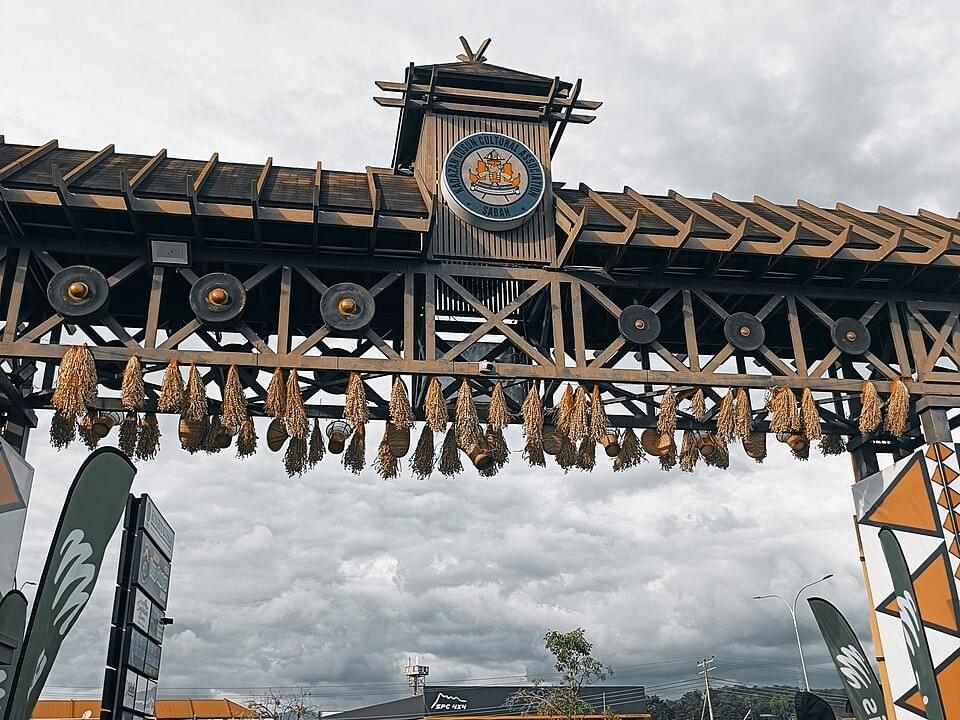
Penampang (June 2) -A candid social media post questioning the relevance of the Kaamatan celebrations at the Kadazan Dusun Cultural Association headquarters in Penampang has struck a nerve among Sabahans, racking up more than 1,400 reactions, nearly 500 comments, and close to 100 shares within days of being published.
The post, written in both Malay and English by a Penampang resident on the Facebook community group Penampang Voices!, laid out a pointed list of grievances about the state of the annual harvest festival at KDCA. Chief among his complaints was the sense that the celebration had become formulaic — the same programme year after year, with traditional houses that once welcomed ordinary visitors now feeling reserved for VIPs, and traditional food that was once shared freely now absent from the grounds. He also raised concerns about visitor safety, the sluggish atmosphere at vendor stalls during daylight hours, and the lack of meaningful public engagement beyond watching the Sugandoi singing competition and the Unduk Ngadau beauty pageant.
"The essence of togetherness in celebrating the harvest festival is not felt enough," he wrote.
The response from the Penampang community was swift and largely sympathetic. Several commenters recalled a livelier, more inclusive KDCA experience in years past. One recalled her last visit in 2023, describing overpriced food, difficulty navigating the grounds with young children, and traditional district houses that felt more like makeshift stalls than authentic cultural spaces. Another went further, saying that if given a choice between KDCA and the Borneo Native Fest held in Kuala Lumpur, she would choose the latter — describing it as more relaxed, more vibrant, and free of any sense of social hierarchy.
A longer, more reflective comment came from a commenter who said he had proposed 25 years ago that a portion of Kaamatan collections statewide be set aside as an education fund for Kadazan Dusun Murut students. He expressed disappointment that no such initiative had materialised at KDCA, contrasting this with smaller community associations that had successfully run loan schemes for their members' children. His comment pointed to a broader frustration: that KDCA's success has been measured too narrowly, with the Unduk Ngadau as its flagship achievement while longer-term community development remains unaddressed.
One commenter, who described experiencing Kaamatan at KDCA during what he called its golden years, said the deeper problem was cultural erosion. "What exists now is only a name that wins on the lips but fades in the soul," he wrote, adding that younger Kadazan Dusun Murut generations were growing increasingly disconnected from the true meaning of Kaamatan as modern activities crowded it out.
However, not all voices were critical. One commenter pushed back, noting that traditional sports and cultural activities are in fact scheduled throughout the two-week celebration leading up to the main Kaamatan dates of May 30 and 31, and that the daytime programme is packed. Her suggestion was practical: that KDCA invest in better live streaming coverage beyond RTK, Sugandoi, and the Unduk Ngadau, so that more of the cultural programming reaches audiences who cannot attend in person.
Another commenter offered a more measured view, saying the adjustments made to KDCA's programme reflect the realities of the current era, and that those seeking a quieter, more village-style Kaamatan experience still have the option of attending celebrations in the interior.
A commenter with a constructive bent offered a detailed list of ideas for KDCA to consider, including storytelling competitions in the Kadazan Dusun Murut language open to all age groups, traditional cooking classes and recipe contests, a village excellence award tied to rice cultivation, and recognition programmes for KDM parents who had supported their children through higher education.
The debate touches on a tension familiar to many of Sabah's indigenous communities — how to keep cultural celebrations alive and meaningful in a modernising society, without reducing them to spectacle. KDCA, as the apex body for Kadazan Dusun Murut affairs, carries the weight of that responsibility each May. Whether this year's wave of public feedback translates into changes to next year's programme remains to be seen.
This report is based on a public post and reader comments on the Facebook community group Penampang Voices!, published on June 1, 2026.
Photo: Jaybikam / Wikimedia Commons (CC0 1.0 Public Domain)