
The housing market in Sabah is becoming increasingly unaffordable for younger generations, with Millennials struggling to secure homes and Gen Z even further priced out. Rising development costs, stagnant income levels, and soaring median prices have combined to create a housing landscape that many young Sabahans simply cannot enter.
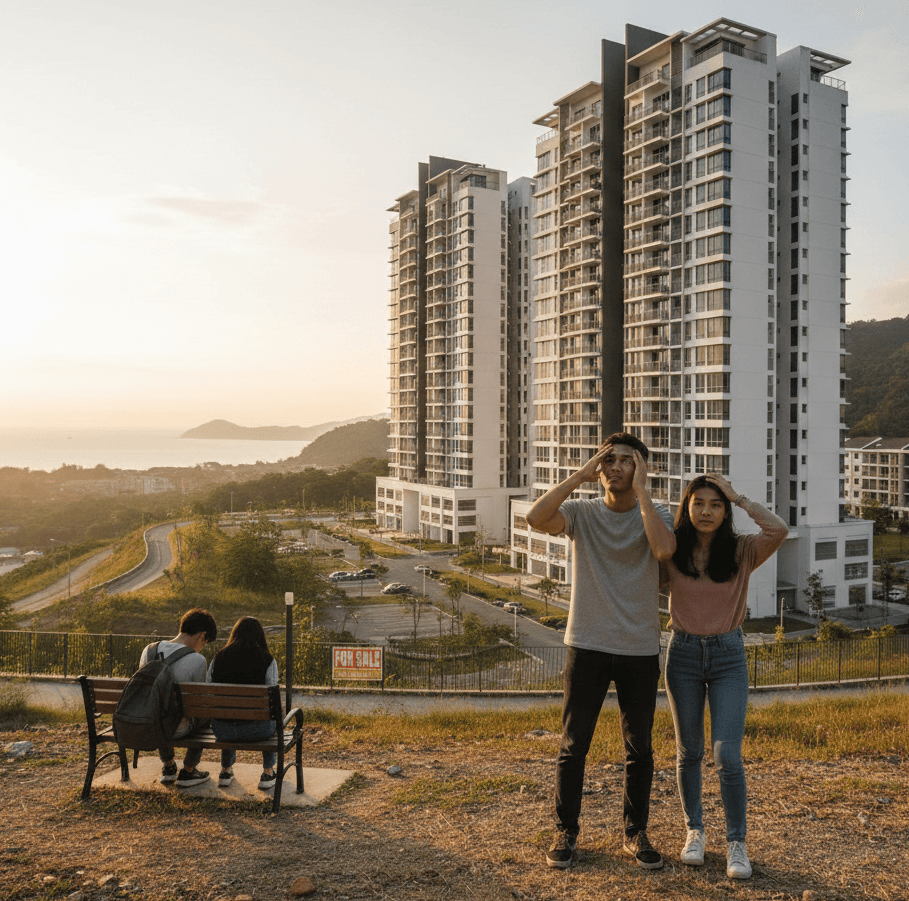
Rising Property Prices Across Sabah
Recent market data from Brickz, which tracks real property transactions, shows that the median residential property price in Sabah stands at around RM360,000, with a transaction range typically between RM250,000 and RM572,500 (Brickz, 2024–2025 data). This reflects a growing trend where new launches—particularly in hot spots like Kota Kinabalu—are priced far above what median-income households can afford.
In comparison, iMoney’s nationwide housing report noted that the national median home price was roughly RM300,000 in 2021, placing Sabah above the national affordability baseline. This underscores how Sabah’s prices have diverged from national norms (iMoney, 2021).
Adding further pressure, The Star reported that Sabah developers are warning of 10%–15% price increases due to rising construction material costs, including cement, steel, and timber (The Star, Apr 2025). These rising costs contribute directly to higher launch prices for new developments.
Why Millennials Are Struggling
Income stagnation is a major issue. According to a Department of Statistics Malaysia (DOSM) analysis on affordability, only about 17.5% of Sabah households can actually afford the state’s median-priced home when applying the standard “house price should not exceed three times annual income” measurement (DOSM, Housing Affordability Report).
Household income levels in Sabah have long trailed the national median, and this structural gap leaves Millennials—those now in their late 20s to early 40s—unable to meet financing requirements or save for down payments at the pace the market demands.
Even what used to be considered “starter homes” now require financial support from family members or dual incomes. For many Millennials, homeownership has shifted from being a rite of passage to a long-term financial challenge.
Gen Z: An Even Steeper Mountain to Climb
For Gen Z, the situation is even more severe. Many are entering the workforce at a time when entry-level units in new developments typically start at RM300,000 and above, as highlighted by market commentary from IQI Global (IQI, 2025). For a generation earning entry-level salaries, these prices far exceed reasonable loan eligibility thresholds.
A PropNex Malaysia analysis on youth homeownership trends also notes that Gen Z buyers are increasingly turning to renting or delaying homeownership entirely, primarily because their preferred housing types—small units in urban areas—are still priced above RM250,000–RM300,000 (PropNex, 2024). For most fresh graduates, these numbers are unrealistic.
Structural Factors Pushing Prices Upward
Several market forces continue to inflate Sabah’s housing prices:
- Construction Costs: A report by Malay Mail in April 2025 stated that rising material and logistics costs could add up to 15% to new home prices, according to Sabah’s housing authorities (Malay Mail, 2025).
- Low Wages: The Edge Malaysia has previously identified Sabah’s property market as “severely unaffordable” due to the persistent gap between median income and home prices (The Edge, Housing Affordability Study).
- Limited Affordable Supply: While some subsale listings remain around RM250,000–RM300,000 (Brickz data), new launches rarely fall in this range, particularly in desirable locations.
These structural challenges create a market where supply does not meet the affordability needs of younger buyers.
Growing Social and Economic Concerns
The unaffordability trend has wider implications for Sabah:
- Delayed family formation as young adults postpone marriage or having children due to housing insecurity.
- Increased long-term renting, which limits wealth-building potential.
- Outflow of young professionals seeking affordable markets in other Malaysian states.
These behavioural shifts are becoming more apparent as younger cohorts voice frustration about housing accessibility.
Government Response
While the Sabah government has expressed its commitment to expanding affordable housing—reaffirmed publicly in 2025 through statements covered by The Borneo Post (Borneo Post, Aug 2025)—critics argue that supply has not kept pace with population needs, especially in urban centres.
Current programmes, including rent-to-own schemes and public-private developments, are helpful but insufficient to counter rapid market inflation.
Conclusion
Housing affordability in Sabah has reached a critical point where Millennials are under significant strain and Gen Z is effectively locked out of the market. Market data, expert analyses, and government reports all point to a widening gap between wages and home prices. Without significant intervention—whether through policy reform, increased affordable housing supply, or financial support mechanisms—younger Sabahans may face a future where homeownership is no longer attainable.
By Barto Erik