
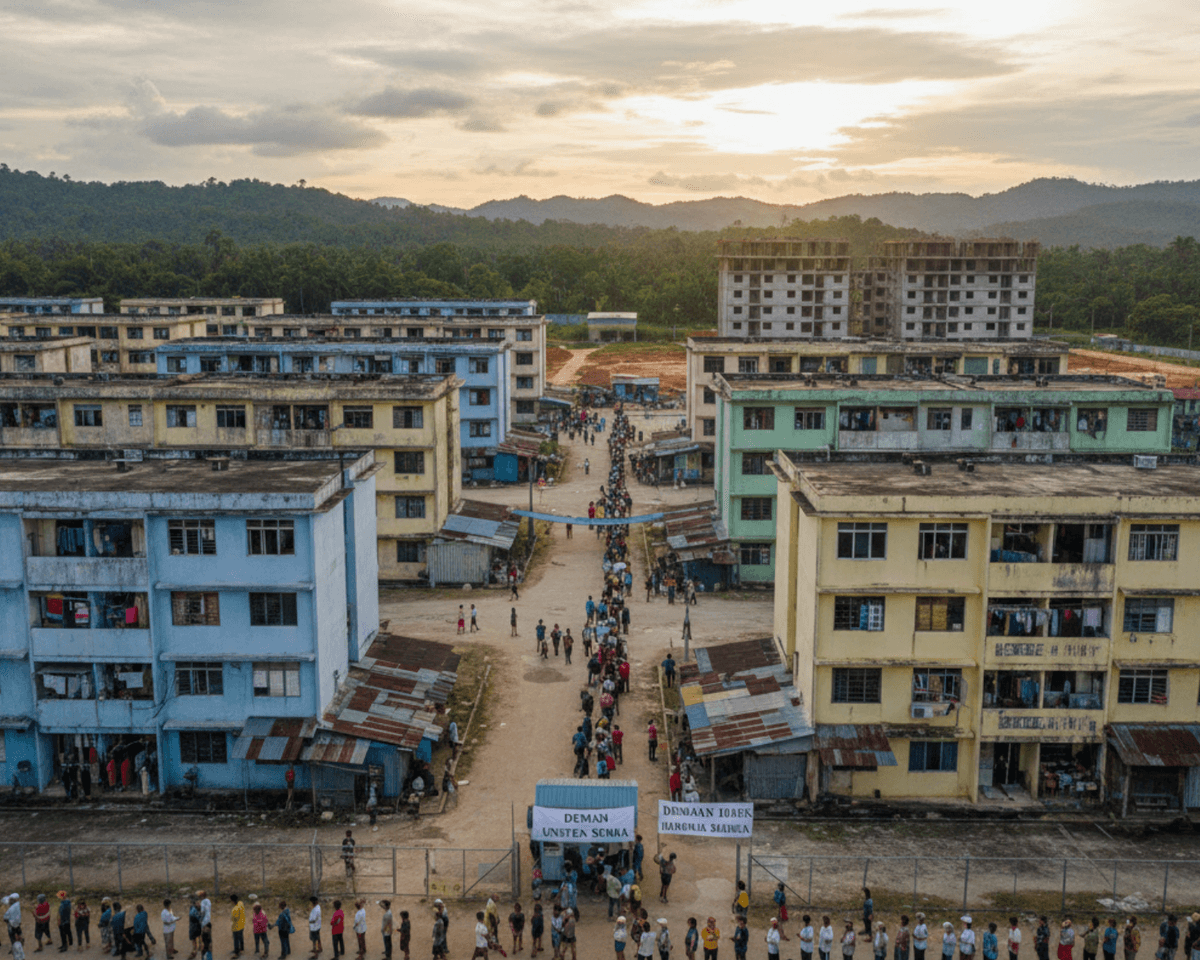
Public housing demand in Sabah has continued to outstrip supply, highlighting a persistent structural issue affecting low- and middle-income households across the state. Despite ongoing government initiatives and periodic project launches, real-life data and ground-level realities show that the pace of public housing delivery has not kept up with population needs, urbanisation and rising living costs.
Growing demand driven by income and urbanisation
Sabah records one of the lowest median household incomes among Malaysian states, while housing prices and rents—particularly along the west coast—have steadily increased. According to national household income surveys often cited in policy discussions, a significant portion of Sabah households fall within the B40 and lower M40 income groups, making them eligible for public or affordable housing schemes.
Urban centres such as Kota Kinabalu, Penampang, Putatan and Sandakan attract continuous rural-to-urban migration for jobs, education and healthcare. This migration intensifies demand for public housing in cities where land availability is already limited. In practical terms, housing offices and local authorities frequently report waiting lists running into the thousands for low-cost flats and public rental units.
Limited supply despite ongoing programmes
Sabah has implemented several public housing initiatives over the years, including low-cost housing projects, Program Perumahan Rakyat (PPR) and state-led affordable housing schemes. While these projects have delivered completed units, the scale has remained insufficient relative to demand.
For example, state assembly briefings and media coverage have repeatedly highlighted situations where applications for public housing exceed available units by multiple times, especially in Kota Kinabalu and Tawau. In some districts, applicants wait several years before being offered a unit, if at all.
One practical challenge is land availability. Suitable, well-located land for public housing is scarce in urban Sabah, and development costs are higher due to terrain, infrastructure requirements and construction logistics.
Rising construction and development costs
Construction costs in Sabah have increased due to higher material prices, labour shortages and transportation costs. These pressures affect both private and public sector developers, slowing the rollout of new housing projects.
Government-linked housing developers often face tight budget constraints, resulting in smaller project sizes or longer development timelines. This means new public housing supply enters the market gradually, while demand continues to grow annually.
Rental pressure reflecting housing shortages
The shortage of public housing has direct spillover effects on the rental market. Households unable to secure public housing are forced into the private rental sector, where rents have been rising faster than wages in recent years. This is particularly evident in areas near industrial zones, hospitals and educational institutions.
Local reports and tenant experiences frequently highlight overcrowding, shared units and informal housing arrangements as coping mechanisms among low-income households—clear indicators of unmet housing demand.
Social and economic consequences
When public housing supply fails to meet demand, the impact extends beyond housing. Families spend a larger share of income on rent, reducing spending on education, healthcare and nutrition. Long commutes from cheaper outskirts also increase transportation costs and reduce quality of life.
From a policy perspective, housing shortages can slow workforce stability, as essential workers struggle to live near employment centres. This has been a recurring concern raised by local councils and labour groups in Sabah.
Final thoughts
The public housing challenge in Sabah is not caused by lack of effort, but by demand growing faster than supply due to income constraints, urban migration, land limitations and rising construction costs. Real-life examples—from long waiting lists to rental market pressure—demonstrate that current delivery levels are insufficient to meet actual needs.
Addressing this gap will require larger-scale public housing projects, better land-use planning, stronger federal–state coordination and alternative models such as public rental housing. Without structural changes, the imbalance between demand and supply is likely to persist, placing continued pressure on Sabah’s most vulnerable households.
By Barto Erik