
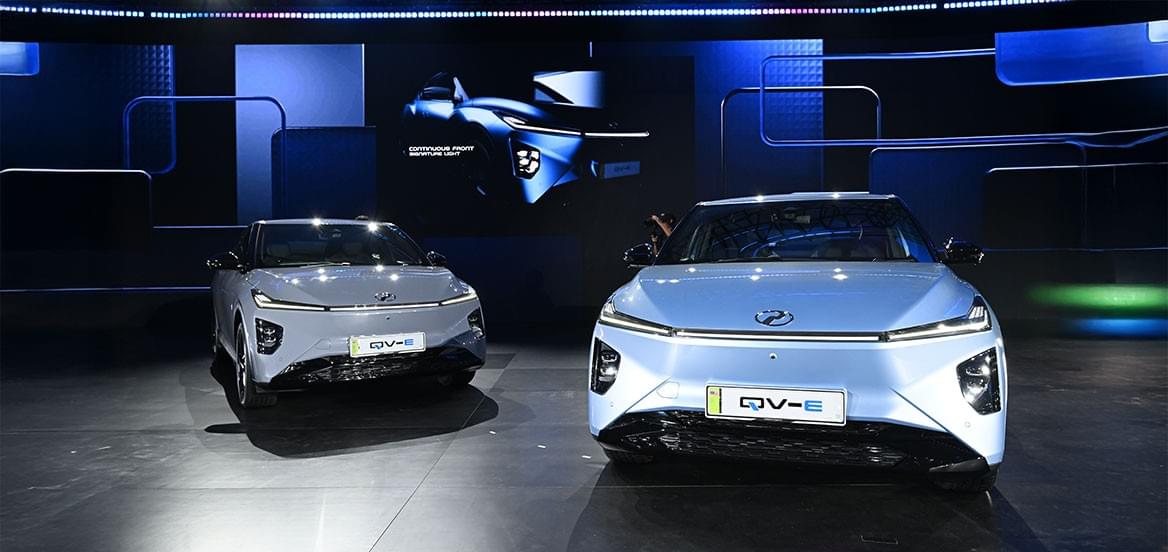
Perodua’s entry into the electric vehicle (EV) market with the QV-E marks a major milestone for Malaysia’s automotive industry. As the brand’s first fully electric model developed with significant local involvement, the QV-E represents more than just a new car — it signals Perodua’s transition beyond internal combustion vehicles. However, while its technology and features have drawn attention, its RM80,000 price point has sparked debate, especially given earlier public expectations of a more affordable national EV closer to RM50,000.
Overview and positioning
The Perodua QV-E is positioned as a compact, urban-friendly EV designed for daily commuting and family use. It adopts a modern hatchback-style profile with aerodynamic styling cues aimed at improving efficiency. The vehicle is assembled in Malaysia and forms part of Perodua’s long-term electrification strategy, which focuses on gradual adoption rather than immediate mass electrification.
Powertrain and performance
The QV-E is powered by a front-mounted electric motor producing around 150 kW of power and approximately 285 Nm of torque. This allows the car to accelerate from 0 to 100 km/h in about 7.5 seconds, offering performance that is noticeably stronger than most Perodua petrol models.
Energy is supplied by a 52.5 kWh lithium iron phosphate (LFP) battery, chosen for durability and thermal stability. The official driving range is quoted at up to 445 km (NEDC), while real-world usage is expected to deliver closer to 350–380 km, depending on driving habits and conditions.
Charging options include AC charging at 6.6 kW, enabling a full overnight charge, and DC fast charging up to 60 kW, which can replenish the battery from 30% to 80% in roughly half an hour. The inclusion of Vehicle-to-Load (V2L) functionality allows the car to power external devices, adding practical value for outdoor or emergency use.
Interior, technology and safety
Inside, the QV-E features a dual 10.25-inch digital display layout, combining a digital instrument cluster with a central infotainment screen. Wireless smartphone connectivity is supported, and vehicle status can be monitored remotely via a dedicated mobile application.
Safety is a key highlight. The QV-E is equipped with six airbags and a comprehensive suite of advanced driver assistance systems (ADAS), including autonomous emergency braking, adaptive cruise control, lane-keeping assistance, blind-spot monitoring and a 360-degree camera system. Additional features such as child presence detection and an emergency SOS system are positioned as value-adding safety enhancements rarely seen at this price level in the local market.
Battery subscription model
One of the most distinctive aspects of the QV-E is its Battery-as-a-Service (BaaS) ownership structure. Buyers purchase the vehicle at RM80,000, but the battery is leased separately through a monthly subscription. Under this model, Perodua retains ownership of the battery and guarantees its performance, including replacement if capacity drops below a specified threshold.
This approach reduces long-term battery risk for owners, but it also means the buyer never fully owns the most expensive component of the car. Over several years, the cumulative cost of the subscription becomes a major consideration when evaluating overall value.
The pricing debate: RM80,000 vs expectations
Public expectations for Perodua’s first EV were heavily shaped by the brand’s reputation for affordability. Many Malaysians anticipated a price closer to RM50,000, viewing the QV-E as a potential breakthrough “people’s EV.” At RM80,000, the car is still cheaper than many imported EVs, but it sits well above what many consider truly accessible.
From Perodua’s perspective, the pricing reflects research and development costs, local manufacturing investments, advanced safety systems and battery technology. The QV-E is not a stripped-down compliance EV; it is well-equipped and competitive on specifications.
From the consumer’s perspective, however, the combination of a higher-than-expected purchase price and ongoing battery subscription costs challenges the idea of affordability. Over long-term ownership, total expenditure may approach or even exceed that of some EVs that include battery ownership upfront.
Is the Perodua QV-E a good purchase for Sabahans?
Whether the QV-E is a good buy for Sabahans depends largely on location, usage patterns and income levels.
For urban Sabahans, particularly those living in Kota Kinabalu, Penampang and Putatan, the QV-E makes practical sense. Daily commuting distances are relatively short, traffic conditions favour EV efficiency, and home charging is more feasible for landed properties or newer condominiums. Electricity costs in Sabah remain significantly lower than petrol costs on a per-kilometre basis, meaning long-term running expenses can be substantially reduced.
However, for rural and interior Sabah, the picture is less favourable. Public charging infrastructure outside major towns remains limited, and long-distance travel between districts such as Sandakan, Tawau, Keningau and Kota Kinabalu can present range anxiety concerns. In these areas, petrol vehicles still offer greater convenience and flexibility.
Affordability is another key issue. Sabah’s average household income is lower than the national average, and an RM80,000 vehicle — especially one with an ongoing battery subscription — places financial strain on many households. For families prioritising value and minimal monthly commitments, a conventional Perodua petrol model may remain the more sensible option.
That said, for middle-income urban professionals in Sabah who value low running costs, quieter driving and modern safety technology, the QV-E can be a forward-looking purchase. Its battery leasing model may also appeal to buyers concerned about long-term battery degradation in Sabah’s warm climate.
Final thoughts
The Perodua QV-E is a significant step forward for Malaysia’s EV ambitions. It delivers strong performance, modern safety technology and practical features suited to everyday use, proving that locally developed EVs can compete on capability.
However, at RM80,000, it is not the mass-market EV many Malaysians — particularly Sabahans — were hoping for. For urban Sabahans with stable incomes and access to charging, the QV-E is a viable and future-ready choice. For rural residents and lower-income households, it remains aspirational rather than accessible.
As Malaysia’s “very own EV,” the QV-E succeeds as a technological statement. Its true test will be whether future models — or pricing adjustments — can bring electric mobility within reach of a broader segment of Sabah’s population.
By Barto Erik